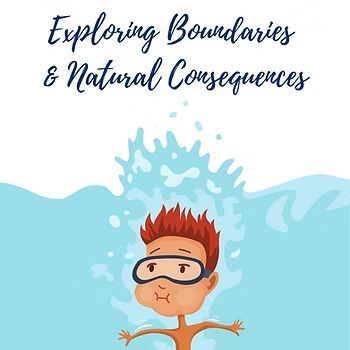
Exploring Boundaries & Natural Consequences
Exploring is a huge part of learning. Children have a deep desire to see, touch, feel, taste, smell, ask questions, and try things independently. It's how they learn and process the world around them.
The pool is no different. To adults, the pool can be a scary place for kids, especially for those that aren't fully equipped with the necessary life saving skills, even if they are in the process of learning them. However, children see the pool as a new place, a place to explore. Some children are more cautious and reserved. Others are ready to explore. It's important to note that every child has different responses to aquatic environments and here at Streamline Teams, we teach our lessons to children's personalities.
To all the parents out there with explorers, this can be hard on your hearts and patience to experience this phase with your child around water. Know that it's very normal and part of the learning process. They want to explore and learn, it is a natural response. It's important for children to feel supported and empowered to succeed in aquatic environments.
We don't want children to view the pool as a scary place. We want them to see the pool as a positive environment that they have self confidence and trust themselves in. The words you use to describe aquatic spaces is very important and translates into how children feel in these environments.
Above all, they are excited. They are stimulated by a new place and want to check out all that it has to offer. Often, when kids leave a skill and attempt to run around the pool, they are in a playful mood and excited to learn about a place they haven't explored yet.
To adults, this often portrays itself as disobedience or bad listening skills.
To the child, it's excitement and curiosity.
Often there are times when they want to skip ahead to skills they aren't ready for that lead to natural consequences. Telling them not to do it usually makes them want to try it more so it's important to have a positive mindset during this process which is difficult to do in some moments as a parent. It's a natural instinct to want to protect your child from harm. Know that it's natural for them to be curious and want to explore.
If you know they are in a safe space, like swim lessons or in your direct supervision, it's hard to watch but it's very important you allow them to test the boundary and explore.
Examples of this are:
- They could have seen a "big kid" jump in at the deep end and want to try it because it looks so fun.
- If they jump in and it's a safe space with you or an instructor present, let them learn what the words "deep water" mean in the moment so they can make a connection to jumping and not to do it in deep water. They don't understand that jumping is okay in the shallow end because they can jump and touch the bottom but not okay in the deep end. In their eyes, jumping is fun and it also looks fun over there. They will learn to understand they need help in that space and there is in fact a boundary with that skill.
- They might drop their toy in the deep end of the pool to watch and see what happens, did it float or sink?
- If they drop their toy in the water and can't reach it from the side they will learn they need help in that space by either falling in or trying to reach it. The goal is to teach them to come ask for help. We work on developing those communication skills in the moment when it happens so children understand what happened and what to do different next time. We want to skill kids up for successful communication so they can express themselves and learn the best actions to take next time.
- The toy they were playing with floated down to a deeper step that is too deep for them to reach independently. They might go underwater and try to reach it.
They are learning about depth perception and refraction here. It looked closer to them than it actually was. They will likely try that skill and learn there is a boundary there that they don't know how to reach the toy yet on their own. They will be in arms reach of you or an instructor and can be pulled up to the surface in 1-2 seconds. When they resurface, it's a great time to talk to them about why it was hard to reach and give them language to use to ask for help. Talk to them about how things look closer than they really are in water. Reinforce this skill development during bath time so they see it happens everywhere in water. This will help them understand that all sinking toys will look like this underwater. They might try this skill again with a different toy and see if the same result happens.
Sometimes they will continue to test the boundaries like these examples at other areas of the pool. They aren't doing this out of disobedience or bad listening. They truly want to see if the same result happens everywhere at the pool. They are exploring and learning.
There is a difference in reckless boundary testing and curiosity.
If children are in a safe place like swim lessons, exploring is welcomed. If you as a parent feel equipped in an environment to let your child explore, that is also a safe place where communication skills and boundaries can be applied and worked on.
Some examples of reckless boundary testing are:
- Child is allowed to jump off a boat without a life jacket.
- Child is jumping off a diving board to a parent at a pool without proper lifesaving skills.
- Child is playing unsupervised in the waves at a beach and end up following the rip current.
At the end of the day, children are curious creatures and truly take in the world around them from their own experiences. It's important to keep this in mind on the harder days to watch at swim lessons or a pool day that becomes not as fun because they are trying to explore and you had another activity in mind. No day of exploration is wasted with children, they are learning and because they are given the space to do so, within reason, they gain knowledge, good boundaries, and quality communication skills to express their needs with.
It's hard to stay positive in the frustrating moments but do the best that you can to see the world from their eyes and seek to offer understanding towards their curious nature.